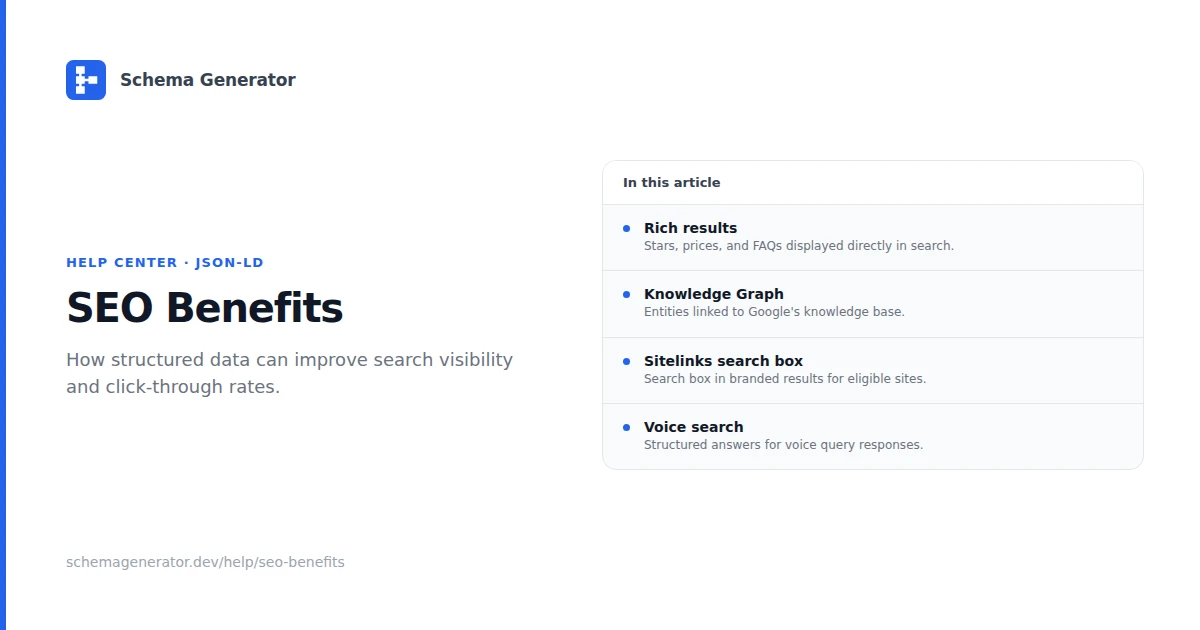
SEO Benefits of Schema Markup
Structured data tells search engines what a page contains: a product, an event, a FAQ, and so on. It does not guarantee rich results or higher rankings, but it improves machine-readable accuracy and can make eligible pages qualify for supported search features.
What schema can affect
Rich result eligibility
When a page meets Google's guidelines and content requirements, structured data may enable enhanced display such as:
- Products: price, availability, review stars (only when reviews are visible on the page)
- Articles: headline, date, author
- Events: dates, location, ticket info
- FAQ: Q&A blocks that match visible page content
Validate every page with the Google Rich Results Test. Eligibility is not the same as appearance in live results.
How search systems use structured data
Google has stated that schema markup is not a direct ranking factor. Practical benefits include:
- Clearer entity extraction for crawlers and answer engines
- Better alignment between page content and query intent
- Preparation for supported rich result types when requirements are met
Voice and answer engines
Assistants and answer systems pull facts from structured data when the page describes entities clearly. Examples: business hours on a LocalBusiness page, recipe times on a Recipe page, event dates on an Event page.
Structured data does not replace visible content. The on-page text still matters.
By page type
E-commerce
Product schema maps name, image, price, and availability. Add AggregateRating only when ratings appear on the page.
Local business
LocalBusiness or Organization schema can publish address, hours, and contact details that match your site footer or contact page.
Publishers
Article schema records headline, author, and publication date. Use WebPage or BreadcrumbList for navigation context where it helps.
Events
Event schema covers dates, venue, and offers when tickets are sold on the page.
Measuring results
Track these in Google Search Console after publishing:
- Enhancements reports for supported rich result types
- Structured data error and warning counts
- Click-through rate changes on pages where markup matches visible content
Compare before and after on the same URLs. A site-wide traffic spike is not attributable to schema alone.
Getting started
- Pick one high-value page type (homepage Organization, product page, or FAQ page)
- Build JSON-LD with the Schema Generator
- Validate with Rich Results Test and validator.schema.org
- Monitor Search Console for errors after deploy
- Expand to other templates once the first implementation is stable
For implementation details, see Implementation Best Practices. For platform-specific steps, see CMS Integrations.